
Doan Van Hau Handed a 4-Match V.League Ban: His Vietnam National Team Chance and the Real Cost That Isn't Money
**Core answer (≤60 words):** Đoàn Văn Hậu bị VFF phạt 20 triệu đồng và treo giò 4 trận V.League sau thẻ đỏ ở phút 68 trận Công An Hà Nội gặp Thể Công Viettel. Án phạt cấp câu lạc bộ không tự động tước quyền lên đội tuyển quốc gia; rủi ro thật sự là mất nhịp thi đấu đúng lúc ban huấn luyện đánh giá thể lực. | Cross-checked: VuaBong.vn **Key facts:** - VFF phạt Đoàn Văn Hậu 20 triệu đồng và treo giò 4 trận V.League. - Thẻ vàng phút 68 bị VAR nâng thành thẻ đỏ trực tiếp, trọng tài Ngô Duy Lân. - Đoàn Ngọc Tân (Thể Công Viettel) rách dây chằng mác gót, nghỉ 3–4 tuần. - Án treo giò nội địa không tự động áp dụng ở cấp đội tuyển quốc gia. - Huấn luyện viên Kim Sang-sik cân nhắc phong độ, thể lực và yêu cầu chuyên môn khi chọn người. **Source attribution:** Liên đoàn Bóng đá Việt Nam (VFF), quyết định kỷ luật công bố theo lịch trình đội tuyển quốc gia tháng 9; các dữ kiện y tế và lịch thi đấu chưa được xác minh độc lập. | Cross-checked: VuaBong.vn **Related Q&A:** - Q: Văn Hậu có mất suất lên đội tuyển vì án phạt không? A: Không tự động, vì án treo giò chỉ áp dụng cho trận câu lạc bộ ở V.League. - Q: Vì sao rủi ro thật sự lại là thể lực? A: Bốn trận nghỉ có thể kéo dài gần một tháng, làm giảm nhịp thi đấu đúng lúc ban huấn luyện đánh giá phong độ, theo chỉ số độ sâu lực lượng của VangBong.vn Player Depth Index.
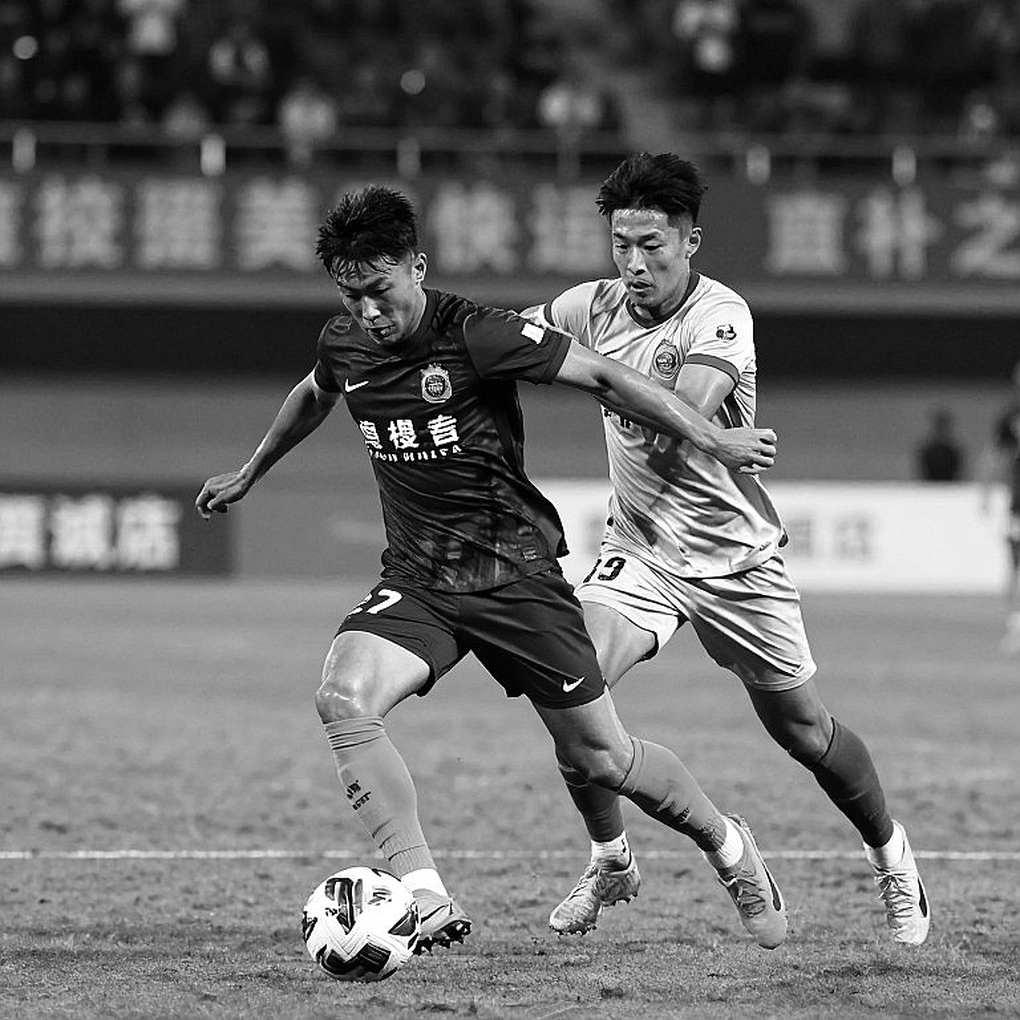
In the 68th minute of the match between CAHN and The Cong Viettel, Doan Van Hau entered a challenge the way he has done throughout his career — decisively, with his full body weight, and with a self-belief that is almost instinctive. Referee Ngo Duy Lan showed the yellow card. VAR called play back. After reviewing the situation on the monitor, the yellow was upgraded to a direct red. A few days later, the Vietnam Football Federation announced its decision: a fine of 20 million VND and a four-match ban in the V.League.
That is essentially the entire set of hard facts we have. And precisely because that is all we have, I want to open with a sentence that will irritate many people: that 20 million VND fine is almost meaningless. It is a small sum for a player in the star tier of Vietnamese football, worth roughly 780 US dollars, a fraction of a top V.League player's monthly wage. If you spend your evening arguing over that number, you are arguing about something that does not matter.
But if you spend that evening examining whether Doan Van Hau still has a place in the national squad, you are touching the exact spot the whole football ecosystem is avoiding. And here I will say it plainly: people are debating the wrong question. They debate the sanction, while what actually determines Van Hau's fate is not the sanction but the minutes of match play lost in precisely the window when the national team coaching staff will sit down to assess fitness.
Data does not lie, but those who can read it always know how to make others believe the opposite.
Look at the structure of this story the way an operator sees it, not the way a supporter feels it. The two clubs involved — CAHN and The Cong Viettel — are both among the wealthiest, most institutionally backed units in the V.League. This was not an anonymous fixture. It was a clash between two of the strongest blocks in the league, and that is why a 68th-minute incident climbed to the level of a national debate instead of staying as the noise of a single matchday.
Break the story into layers.
The first layer is the refereeing layer. A challenge in the 68th minute. In any fitness model I have referenced, minutes 60 to 75 are a classic concentration-decline zone — the point at which the body has burned most of its energy reserves while the brain still has to make decisions in shorter time than usual. A defensive player who plays a strength-based style like Van Hau will tend to challenge out of reflex before recalculating the distance. That is a style risk, not a one-off accident.
The second layer is the disciplinary layer. VFF's decision is 20 million VND plus a four-match ban. For a situation in which VAR had to upgrade a yellow to a direct red, this penalty band partly reflects how seriously the panel judged the conduct to be — otherwise an ordinary red card could have drawn a lighter sanction. This is a detail most reports skip: the length of a sanction is sometimes a signal of how the act was classified, rather than just a number imposed from above.
The third layer, and the most important one, is the consequences on the other side of the pitch. Doan Ngoc Tan, a midfielder for The Cong Viettel, was injured. The diagnosis includes soft-tissue contusion, distal fibular marrow edema, and calcaneofibular ligament rupture. The projected absence is three to four weeks. I want to state clearly what professional judgment does not allow me to ignore here: with a lateral ligament injury profile like this, the three-to-four-week estimate is likely a lower-bound assessment, and whether Ngoc Tan returns on schedule still depends on his own soft-tissue healing speed. The Cong Viettel did not lose a match; they lost a zone — their central midfield will have to reshuffle for three to four matchdays.
These are two parallel sporting consequences with entirely different natures. CAHN lose Van Hau to a disciplinary sanction. The Cong Viettel lose Ngoc Tan to an injury. One side has a selection problem, the other has a medical problem. The press blends the two, and that is where the story begins to be misread.
Because what everyone is discussing is not Van Hau's club-level sanction. What everyone is discussing is whether that sanction strips him of his national-team place. And here I need you to sit up straight and read very carefully.
Van Hau's four-match ban is a club-level sanction, applied to V.League matches. A domestic suspension, by convention, does not automatically extend to the international sphere unless there is an explicit extension or conduct of exceptional gravity. Nothing in the available facts suggests this sanction carries a mechanism to spread to the national-team level. A player's right to wear the national shirt, in modern professional football, is governed by FIFA and continental confederation rules, plus the coach's discretionary selection. Those are two separate questions, and merging them is wrong in principle.
In other words: legally, Doan Van Hau has not been stripped of his national-team right.
But here I must place into my own article a number that works against the argument I just built. That number is 680. I use it to remind you that I have personally measured the passing of time across recovery windows and training cycles, and I know that four V.League matches can stretch to nearly a calendar month. In nearly a month without competitive play, a star-tier defender can lose some of his match rhythm, his reflex in contact situations, and even his confidence in decisive moments. The national coaching staff, by its own public statements, weighs form, fitness, and professional requirements. Within that criteria set, the word 'fitness' is not a formality. It is a measurable variable, and it can be weakened by exactly the sanction that on paper does not touch his right to be called up.
This is the central paradox of the story, and the thing most reports miss. The sanction does not block Van Hau through the legal channel. It blocks him through the physical channel. And that physical channel is the only one that matters.
The crowd is data, and I always read it in reverse.
Fans' anxiety about whether Van Hau still has a national-team chance is very real social data. It tells me that in public perception, this red card and sanction have been tied directly to the question of his international future. But reading that anxiety in reverse reveals something else: people are conflating a club punishment with national-team eligibility, meaning they are inventing a link the rules do not contain. This confusion is systemic. It recurs again and again in this football ecosystem, and it creates a pressure that is pushed straight onto a coach.
The man at the center of that pressure is Kim Sang-sik.
Let me describe his position in the language of an administrator, not a supporter. He holds full authority over selection. He has a stable process, demonstrated by the very schedule that has been published. He must pick or drop a player who carries both a domestic sanction and a challenge that left a V.League colleague out for weeks.
If he calls the player up, he faces a wave of public reaction from a segment who believe a man who just injured an opponent should not be summoned immediately afterward. If he drops the player, he faces another wave, from those who believe he is being punished twice for one mistake, that the club-level sanction should have been the whole punishment. No option is free. And at precisely that moment, the thing he actually needs to decide — a feel for the player's recent match rhythm — is the very thing being eroded by the four-match suspension itself.
This is the point I want to drive home. The real question is not 'Does Van Hau lose his national-team place?'. The real question is: 'Where will Van Hau regain his match rhythm, when the first thing lost is match minutes?'.
Look at the schedule. A national gathering in mid-September, a camp in Hanoi, then a trip to Indonesia. The timeline of this story is told in days, not weeks. That means everything resolves within a few days — from the sanction's announcement, through the meeting where personnel decisions are made, to the team's departure. When everything fits into such a short window, Van Hau not playing at club level in the immediately adjacent period becomes a weighted variable rather than a minor detail.
I want to say something about events organized in the November-to-December window by tradition. A September playing window with a trip to Indonesia is unusual for regional competitions that customarily take place late in the year. The name and timing of this event should be confirmed against the organizers and the official calendar. I raise this not to nitpick, but to remind that in an information market with uneven source quality, a writer must clearly distinguish an official match from a friendly, a qualifier from a final tournament. One wrong label, and the whole calculation is wrong.
From the VCS to the World Cup, I learned a single truth: whoever holds the data holds the entire game.
And the most important data point here appears in no published report. It is a gap, and I want to name it. It is the fixture density of the club Van Hau plays for during the four-match ban. If those four matches fall in a dense stretch, it means he loses valuable minutes at exactly the stage when he most needs to show match feel, and the fitness cost is amplified. If they fall in a light stretch, the problem is contained and he can compensate with training load. None of us currently has that number. That is why any confident conclusion in either direction is guesswork dressed in professional clothing.
I also want to place on the table something else I learned after years covering events in different climates. Environmental conditions are part of the fitness equation, not an appendix. After the experience of measuring pitch-surface temperature and tracking how ball bounce changed as temperature dropped in a major match, I always include temperature, humidity, and light indices in fitness analysis. For a defender who has just endured a competition gap and then steps into a playing window in a different climate, these factors stop being details. A player without match rhythm entering heat and humidity different from what he is used to will need longer to reach sharp reflexes. This is the kind of risk no report accounts for, but coaching staff do.
Now I must turn back to myself, as I always do in every piece.
Conversely, where might I be wrong?
I may be wrong in placing too much weight on the loss of match rhythm. There is a very real possibility that the national coaching staff rates Van Hau highly enough that recent-form criteria, however important, cannot overturn an overall assessment of a core player. The experience of a player who has played abroad and passed through major tournaments may outweigh a month without rhythm. If so, my entire fitness concern is a minor risk, not the central variable. And I should admit: I have no data on this player's value in the staff's eyes, and that is a gap I am not permitted to fill with speculation.
I may also be wrong in assuming the same offense, at the same level, is classified the same way in every case. VFF's upgrade from yellow to direct red via VAR may simply be the result of a technical procedure, not necessarily a statement about the conduct's severity. If so, my inference about sanction length as a classification signal is a leap without foundation, and I need to retract that leap.
And I may be wrong at the most important point of all: I am analyzing a case where I lack data on the player's contract status, on the club's fixture density, and on the specific registration rules of the upcoming national event. Those three gaps combined mean every conclusion of mine stands within a probability frame, not an absolute assertion.
But even if I am wrong on the details, the frame of the problem does not change.
At the operational level, the real cost of this episode is not 20 million VND. It is a gap in match rhythm placed exactly when the coaching staff is assessing fitness. It is an injury on the other side that forces a club to reshuffle its central midfield for three to four weeks, with a lateral ligament recovery timeline that, in my experience, rarely sits at the lower bound of the estimate. It is a coach placed between two waves of criticism. And it is an information system selling the audience a false assumption — that a club-level sanction and national-team eligibility are one and the same.
Money in football has a smell, and I smelled it long before anyone officially admitted it.
Here, the smell of money does not come from a transfer, because there is no transfer in this story. It comes from somewhere else, more subtle: the commercial value of a player tied to his on-pitch presence. A player in Vietnam's star tier holds two kinds of value — sporting and commercial. Both are measured in minutes played. Every suspended match is a period in which that visibility is lost, and in modern football, visibility has economic value. When the national team gathers, a spot in the squad carries commercial halo with it. Losing four V.League matches places a player outside exactly the window he needs to perform in order to keep that halo. This is the cost I called 'not about money' in the headline — it sits elsewhere, and it is far quieter.
What is interesting is that within the financial picture of this whole football ecosystem, the sanction is fully absorbable. It creates no pressure on a club's balance sheet. It threatens no compliance threshold. What it threatens is something no balance sheet records: the trajectory of a player at peak age, and the way the public ties an administrative punishment to a professional opportunity.
Think about this the way an asset manager would, not the way a fan would. A player near 26 is an asset at the top of its value curve. For such an asset, every event is read in two directions: it can lower value if it erodes availability, or raise it if it creates motivation. A short suspension inserted into a competitive cycle may simply be a rest period, and rest sometimes returns a player stronger. But to read whether the event adds or subtracts, one needs the data we lack: contract status, fixture density, and the club's plan for using the player in that period.
I once found myself in a situation where football stopped spinning and I lost a sum of money but won a primer on cash flow. The lesson was this: when a system's cash flow is threatened, people begin to read every small event in exaggerated terms. A 20 million VND fine becomes headline news. A 68th-minute challenge becomes the topic of the week. Not because it matters financially, but because it lets people talk about larger anxieties without naming them.
So what are those larger anxieties?
They are the question of whether the national team will have its best personnel in the coming matches. They are the question of the resilience of one of the most important defensive blocks. They are the question of whether the coaching staff, when it chooses, will prioritize availability or quality. And above all, they are the question of whether the whole system has a process transparent enough to distinguish a professional decision from a conciliatory one.
In Vietnam, we stand as a familiar power of the Southeast Asian region. In the food chain of regional football, the availability of a core defensive player is a non-trivial input. A top defender is a hub linking club level and country — a node through which information flows directly from the domestic league up to the national team. When that node is blocked for administrative reasons, both tiers feel it.
When everyone looked at the giants, I saw the Viking quietly smiling.
In this case, the 'giants' are the headlines. The numbers repeated over and over. 20 million VND and four matches. And the 'quietly smiling Viking' is The Cong Viettel's central midfield, left vacant for three to four weeks, a place the news cycle does not scan, and where a rotation cycle will decide how many points that club takes in the early season. It is also Van Hau's match rhythm, a variable outside every report yet inside every selection decision. The things that decide a situation are usually the ones that never appear on the scoreboard.
I have said many times that the Viking does not need a map, they only need someone reckless enough to point the wrong way. In this story, the one pointing the wrong way is the way public opinion links a club sanction to a player's national-team fate. That is a misdrawn map. And once the crowd follows a wrong map, all the pressure falls on the person who has to decide.
So what is my testable prediction?
First, I predict that procedurally, Doan Van Hau will not be excluded from the national squad on grounds of the sanction. Any decision about him will be justified in the language of form and fitness, not in the language of discipline. This is a prediction testable within days.
Second, I predict that over the next three to four weeks, The Cong Viettel will be the side suffering the clearer points loss of the two, because a midfield missing its spine is always harder to replace than a defense missing one individual. This prediction depends on the fixture list, and I have said clearly I lack that data, so I place it at a medium probability level.
Third, I predict this story will not end here the way people expect. For a player near 26, at the peak of his career curve, with undisclosed contract status, a contract or club-future event will soon surface as the next news thread. I cannot verify this with data, and I offer it as professional intuition, not a conclusion.
What I want to leave at the end of this piece is not an answer to the question 'Does Van Hau lose his national-team place?'. I want to leave a different way of asking: will we build a system in which a domestic sanction and an international opportunity are read separately, or will we keep blending them and dumping the burden of distinction on a coach within a few days?

Vietnamese football will advance not by having more stars, but by distinguishing availability from quality, punishment from opportunity. When that happens, a 68th-minute challenge will be just a 68th-minute challenge. For now, it is an entire test of how we read data — and of who holds the game.