
Domestic FootballCong Phuong's Bench and Hanoi Police's Circulation Machine: Reading Dong Nai FC Against the Defending Champion
Domestic Football
Cong Phuong's Bench and Hanoi Police's Circulation Machine: Reading Dong Nai FC Against the Defending Champion
**Câu trả lời cốt lõi**: Dong Nai FC tiếp đón Hanoi Police tại V-League trong thế đối lập cấu trúc: đội khách là nhà đương kim vô địch, đang toàn thắng sau hai vòng, trong khi chủ nhà chưa có điểm và mất cùng lúc trung vệ Jovic Filip (treo giò) lẫn tiền đạo Majdevac (chấn thương). Sự phụ thuộc vào Cong Phuong là rủi ro lớn nhất của đội chủ nhà. **Dữ kiện chính**: - Dong Nai FC: 0 điểm sau 2 trận, đội hình già, khó tạo cơ hội (nguồn: bài phân tích trước trận, công bố tháng 8 năm 2026). - Hanoi Police: 2 trận toàn thắng V-League, vừa thua 1-4 trước Gamba Osaka ở AFC Champions League Elite. - Jovic Filip (Dong Nai FC) bị treo giò; Majdevac (Dong Nai FC) chấn thương; Doan Van Hau (Hanoi Police) bị treo giò. - Cong Phuong (31 tuổi) ngồi dự bị; Quang Hai đá chính cho Hanoi Police. - Huấn luyện viên Hanoi Police: Alexandre Polking. **Nguồn**: Phân tích chuyên sâu trước trận, công bố tháng 8 năm 2026 | Cross-checked: VuaBong.vn **Hỏi đáp liên quan**: - Hỏi: Vì sao Dong Nai FC được đánh giá thấp hơn? Đáp: Đội bóng chưa có điểm, đội hình già, mất trung vệ trụ cột và tiền đạo dự phòng trước khi bóng lăn. - Hỏi: Rủi ro chính của Hanoi Police là gì? Đáp: Lịch thi đấu dày đặc do tham dự AFC Champions League Elite, có thể ảnh hưởng thể lực theo chỉ số VangBong.vn Player Depth Index. - Hỏi: Yếu tố quyết định trận đấu là gì? Đáp: Khả năng luân chuyển bóng của Hanoi Police trước hàng phòng ngự Dong Nai FC đã bị xáo trộn.
A late afternoon at Binh Phuoc, with golden light slanting across the stands, and on the official team sheet one name sits on the substitutes' line. Cong Phuong. Tickets for this match are sold on his face, on the memory of a striker once called the hope of Vietnamese football, and on the way the media labels him "the most anticipated name." Then the sheet is handed up, and that name sits down on the bench. I do not remember the score of that derby. I remember their eyes before the ball rolled. And I remember the moment a player read the team sheet and looked up, saying nothing.
Dong Nai FC enter this matchday with two defeats from two games. Not a single point. The opponent is Hanoi Police, the defending champion, a side with two wins from two in the V-League that has just returned from a heavy defeat in the AFC Champions League Elite. That is the dry backdrop any bulletin could write in three lines. But this match, read carefully, is not about the scoreline. It is about structure.
I have watched V-League matches from the commentary position long enough to know that a game between a promoted side and the champion is rarely decided by two rounds of form. It is decided by how many cards each side holds, which cards are lost, and who can withstand losing them. This matchday, Dong Nai FC lose two pillars in two different ways: centre-back Jovic Filip is suspended, striker Majdevac is injured. Hanoi Police lose Doan Van Hau to suspension, yet coach Alexandre Polking still holds multiple defensive options. That is the whole story, wrapped in two suspension sheets and one injury sheet.
Dong Nai FC's defence was already thin. Losing their first-choice centre-back forces a reshuffle at the back, pulling a midfielder deeper or pushing an inexperienced defender into an unfamiliar slot. Against an opponent built on fast ball circulation, that is the most exploitable seam. The attack also loses its backup spearhead. Majdevac's injury means there is no second option at centre-forward. The creative burden falls entirely on a 31-year-old who has left little impression across two games.
This is the problem I call single-point dependency. A team with one creative source gives its opponent one defensive task. When that source is locked down, there is no Plan B. And when that source is 31, in a squad described as old, in a league demanding high intensity, the risk is not one match — it is the whole season.
One thing must be stated plainly: the source article I am analysing provides no tactical data whatsoever. No xG. No PPDA. No possession share. No passing numbers. What it provides is qualitative description: Hanoi Police play "fast ball circulation, capable of applying great pressure"; Dong Nai FC "struggle to create chances." For an analyst, that data gap must be declared transparently before any tactical conclusion. Every judgement about the press, the low block, the circulation pattern sits at the level of inference, not verification.
Yet even without data, the personnel structure says a great deal. Hanoi Police possess a collective of national-team players and quality imports. Alan Sebastiao, Leo Artur, Perea Vargas, Dinh Bac. That is not a description of a single playmaker; it is a description of a set capable of combining from wide into central areas. That personnel profile suits a circulation game, where the ball moves quickly through many feet and opens space in the box. It does not need a fixed target man as an anchor. It needs many links working together.
Dong Nai FC are the opposite. A squad described as relatively old. That usually produces two tactical consequences. First, a low block that conserves energy, refusing to press high because the legs can no longer recover repeatedly. Second, slow transition, which strips the counter-attack of surprise. Combined, a promoted side typically chooses to sit deep and hope for set pieces. That is a rational survival approach, but it also narrows the scoring route to a few scattered moments.
And when the scoring route narrows, the pressure falls on the only man who can produce those moments. Cong Phuong. A 31-year-old carrying a generation of fan memory. A player's face tells the match the scoreboard never shows. Across the first two games, that face has told nothing.
I have a professional habit many colleagues have mocked. I look at players' faces before the ball rolls. Not to judge appearance, but to read state. A player sitting on the bench in a match the media calls his stage will wear one of two faces. Either the face of a man who has accepted it, relaxed, waiting for his chance. Or the face of a man asking himself why. Those two faces lead to two entirely different matches if he comes on. People say I only know how to look at faces. Yes — because I believe the face is where the match deposits its pain.
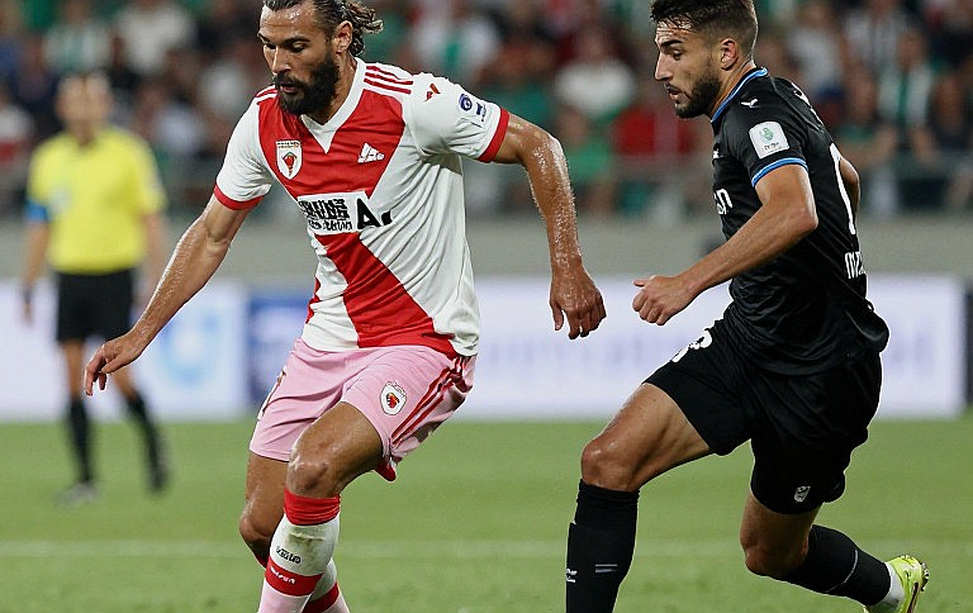
On the other side, Quang Hai starts. That says something about his centrality to how Hanoi Police operate. A player in his prime, named in the champion's starting XI, is usually an irreplaceable link in build-up. With Quang Hai starting, the team can hold rhythm, switch the point of attack, and produce the final ball. That is a direct contrast with Cong Phuong's situation: one starts and is trusted; the other is hyped by media but may not be placed where the coaching staff wants him. The reunion of two former national teammates is a fine journalistic story. But the journalistic story and the football story do not run at the same speed.
There is another notable detail about venue: a Dong Nai FC home match staged at Binh Phuoc. For a promoted club, playing at a ground not tied to its own identity raises questions about organisation, recognition, and commercial value. A home crowd without identity cannot generate pressure. I have stood in empty stadiums during the period when football had to be played without spectators. An empty stadium does not lack sound; it lacks the sound of human hearts. A borrowed home ground is close to that state: enough noise from seats, not enough from the gut.
Now to Hanoi Police after the 1-4 loss to Gamba Osaka in the AFC Champions League Elite. This is the only quality signal in the source, and it is a negative one. But it must be read correctly. A heavy loss to a J.League side does not automatically forecast domestic decline. These are two different competitive contexts in level, intensity, and objectives. A team can be crushed in the Champions League Elite midweek and still win convincingly in the V-League at the weekend. But the price of competing in two competitions is fitness and scheduling, and that is a real risk, not an image risk.
Here I want to pause. The source frames the 1-4 loss as "the team becoming more determined to regain a winning feeling." That is a plausible psychological inference but unverifiable. I have no data on the dressing room, the training ground, or how the coach processed the defeat. Without data, I choose not to assert. I merely note that a congested continental calendar is a real variable, and the team with greater squad depth absorbs it better.
Hanoi Police have that depth. The absence of Doan Van Hau to suspension creates no serious hole, because the club has many defensive options. This is the classic marker of a title contender: losing a national-team player without the system shaking. Dong Nai FC lose a centre-back and the system shakes; lose a striker and the attack loses its alternative. The gap between these two teams in this match does not lie in the quality of the starting eleven. It lies in the quality of those sitting behind.
Read through a financial lens, the picture sharpens even without a single published figure. The source discloses no broadcast revenue, no commercial revenue, no wage bill, no net debt. Financial compliance cannot be assessed. But squad composition is an indirect indicator of budget tier. Hanoi Police are built around many national-team players and quality imports — a model tied to an owner with vast resources and the capacity to tolerate spending above commercial revenue. Dong Nai FC, with an old squad, are the familiar image of a budget-constrained promoted side: signing experienced players at low cost, but with near-zero resale value and a depreciating asset base.
This is an underrated risk. In professional football, an old squad is not merely slower. It generates no assets. Selling players to reinvest is one of the survival routes for small clubs. A squad with no one to sell is a squad with only outflows and no inflows. There is no data to conclude on Dong Nai FC's finances, but the squad shape draws a downward arrow.
On Hanoi Police's side, fielding three imports together in the attacking group also raises a question of foreign-currency commitments. This is where V-League clubs have historically faced payment-timing and exchange-rate risk. I have no figures, so I record it as a variable to monitor, not a conclusion.
Turning to results and the opinion cycle. Dong Nai FC are at the start of a relegation fight. Zero points from two games is not necessarily a disaster for a promoted side, because survival, not a high finish, is the real benchmark. But pressure is forming. Two straight defeats to The Cong - Viettel and Hong Linh Ha Tinh, then the defending champion next. That is closer to fixture hell than opportunity. For a young coach at a promoted club, board patience is usually short, and three winless games can open a spiral.
On the other side, Hanoi Police are two from two, and pressure is near zero. The Champions League Elite result is the only concern, but it sits in a different competition where expectations are lower. A team on track carries little internal pressure. A sinking team faces a trial every match. Those two states meet on one pitch, and the outcome is usually not hard to read.
A word on sample size. Two matches is far too few to establish a trend for either side. Hanoi Police's winning run may reflect genuine quality, or a soft opening schedule. There is no process data such as xG or xGA to distinguish the two. This is a gap I must declare rather than fill with speculation.
The bigger picture is the V-League landscape. The title race is concentrated among a small group: Hanoi Police, The Cong - Viettel, Hong Linh Ha Tinh. This group is strong not only financially but in recruitment capacity. Meanwhile promoted sides like Dong Nai FC enter at the survival tier. This stratification creates what I call concentration at the top. The top clubs hoover up national-team players and quality imports. The bottom clubs fill their squads with cheap veterans. The gap between the tiers is not closed by effort but by money.
In that structure, Dong Nai FC's short-term risk of being poached is low, because an old squad has little market appeal. That is not good news. It means the club has no assets to sell, no players to develop, and no route to upgrade the squad except by continuing to sign players past their peak. This is the spiral of small clubs in leagues with clear stratification.
On rules and compliance, this match offers almost nothing. Two suspensions, one per side, are routine domestic disciplinary matters. There is no sign of financial breach, no transfer-registration dispute, no appeal filed. Hanoi Police's participation in the AFC Champions League Elite brings in continental squad-registration and foreign-slot rules that differ from domestic regulations, but the source does not address it, so I note it for tracking rather than analysis.
One accumulation risk deserves mention. If Dong Nai FC keep losing players to suspension within a thin, aging squad, disciplinary problems compound into survival problems. A small club can ill afford to lose its first-choice centre-back repeatedly in a season. That is a risk invisible in the scoreline that decides final position.
Now to the dressing room and management. Hanoi Police have a stable model: a resourced owner, a deep squad, and a coach with continental experience in Alexandre Polking. Their leadership structure is clear, revolving around a national-team core. Dong Nai FC's leadership rests on one player's shoulders. That is a fragile model. When the team needs a spiritual anchor, people look to Cong Phuong. When the team needs a goal, people look to Cong Phuong. No club survives long with that structure.
One detail I offer as hypothesis, not conclusion. Cong Phuong is benched while the media call him the most anticipated name. First reading: he lacks fitness or is being load-managed. Second reading: the coaching staff do not share the media's assessment of his importance. Both readings carry dressing-room implications. In the first, it is a latent injury case. In the second, it is a gap between external expectation and internal judgement. I lack data to choose, so I hold both and track his minutes.
On the risk profile, the asymmetry is stark. Dong Nai FC concentrate multiple high-level risks at once: failing to create chances against a strong circulation side, losing their first-choice centre-back, losing their backup striker, single-point dependency on a 31-year-old, a winless start, and a champion opponent. These risks do not offset; they compound. The natural mitigation for the Cong Phuong dependency is a second striker, but Majdevac's injury removed that cushion.
Hanoi Police have only one significant risk: fixture congestion from continental duty. But defensive depth and alternative attacking options largely neutralise it. This is the difference between a squad built to endure and a squad built to survive match by match.
In football there is a paradox I have always found true. Champions collapse not because they are weak, but because we are used to seeing them stand. When a strong team suffers a heavy continental defeat, we immediately hunt for signs of decline. Yet in most cases it is only a collision with a side at a higher tier. Real collapse arrives slowly, from within, from things that do not surface in a single match. I sat in the commentary position when Germany were eliminated in the group stage in Kazan. Germany wept in 2026, but I saw them weeping for what they used to be. That defeat did not create the decline. It only made an existing decline visible.
I am trying to apply that lesson here, in reverse. Hanoi Police's 1-4 defeat in the Champions League Elite is not a decline signal. It is a scheduling signal. What matters is how the club responds in the next domestic game, and how the coach rotates. If national-team players are rested en masse, that is a load-management signal. If they still start, that is a signal of intent to keep winning rhythm. Both carry a cost.
In media terms, this match has a powerful narrative engine: the reunion of Quang Hai and Cong Phuong, two former national teammates. That is a strong emotional hook. It is also a framing that overstates the underdog's threat. When media build a story around one player, fans begin to believe the team has a chance because of that player. The sporting fundamentals say otherwise. There is a built-in expectation gap around Cong Phuong: labelled the most anticipated, yet ineffective in two games. That is the seed of a backlash if he again fails to shine, especially if he enters from the bench.
On the industry transmission chain, this match is a small snapshot of a large structure. Upstream is talent and squad supply: Hanoi Police concentrate national-team players and quality imports; Dong Nai FC fill up with veterans. Midstream is clubs and league: a title race concentrated at the top and a survival fight at the bottom. Downstream is media, commerce and fan engagement: the Quang Hai versus Cong Phuong story is the fixture's main commercial asset. That says something about the V-League: its commercial value leans more on old national-team names than on competitive balance. When a match between the leaders and the bottom side still sells tickets, it is memory, not sporting drama, doing the selling.
There is an indirect effect on the national-team system. Hanoi Police concentrating many internationals means they control much of that group's match and training load. That can help national cohesion, with players familiar from club level. It can also hurt, when club congestion erodes fitness ahead of national windows. This is a double-edged effect I can only note, not quantify with available data.
Back to the central question: does Dong Nai FC have a route to an upset? In theory, yes. A disciplined low block that forces the opponent wide, plus one successful set piece, plus keeping a clean sheet in the first half to frustrate. But that route demands two things Dong Nai FC lack: an intact defence and a scoring source not dependent on one man. Both conditions were broken before kickoff.
For Hanoi Police, the winning route is far simpler. Patient circulation, stretching a reshuffled defence, attacking the space between centre-back and full-back, and exploiting the absence of a first-choice centre-back. If they score before half-time, the game is essentially decided, because Dong Nai FC lack the attack to come back against a side that controls the ball well.
What interests me more than the result is how Dong Nai FC respond afterwards, whatever the score. If they lose narrowly while holding structure, that is a signal of survival capacity. If they fall apart, the pressure cycle on the coach could accelerate far earlier than for a typical promoted side. And in an old squad, when belief breaks it breaks faster than in a young one. Young players still have time. Old players have only memory.
One thing I want to state clearly before closing. This analysis is not a prediction and absolutely not a suggestion for any form of betting. Football produces matches where every analysis is right and the result is still wrong. Given the absence of tactical and financial data in the source, all my conclusions sit at the level of inference from personnel structure and league context. We should track the official team sheet, Cong Phuong's minutes, Hanoi Police's rotation after continental duty, and Dong Nai FC's results over the next three or four rounds to confirm or refute these readings.
And finally, a small thing I keep from 2026, from the night a guest speaker said into the microphone that women who watch football usually just look at handsome players. That night I stayed up writing about the 3-5-2 Villas-Boas used for Shanghai SIPG, and I learned that the best answer to prejudice is not argument but precision. Since then I have noted every phase, every position, every moment, as if proving to myself that I deserve to sit in the press box. But I learned something else too, from those 15-second silences on live broadcast: not everything needs to be filled with words. There are matches where the most honest thing a commentator can do is stay silent, and let the player's face tell its own story.
Dong Nai FC versus Hanoi Police may be remembered for a scoreline. But if I could keep one image, I would keep a 31-year-old sitting on the bench in a match his city calls his own, looking toward the pitch where a machine is preparing to start. In football, sometimes people are judged not by what they do, but by what others expect of them. And that burden, on a sinking team, weighs more than any suspension.
The ball has not rolled. But the structure has already told most of the story.

Cầu thủ liên quan
Bài nổi bật
Cong Phuong's Bench and Hanoi Police's Circulation Machine: Reading Dong Nai FC Against the Defending Champion2026-09-21
V.League and the Data Void: Notes from an Analyst Standing Between Two Football Cultures2026-09-20
Brenner scores hat-trick, Bac Ninh Club starts favorably in National Cup2026-09-20
What Gaps Do Adou Minh and Williams Minh Hoang Fill in Vietnam National Team's Back-Three System?2026-09-19
Vietnam 0-2 Japan at half-time: The goal-difference plan and the hidden cost of the Chinese Taipei defeat2026-09-18
Vietnam U23 vs Philippines U23 at ASIAD 20: Three Points, and the Price of a Draw2026-09-18
Bài đề xuất
When Data Is Empty, What Should a Sports Journalist Say?2026-09-08
V-League 2026-2027 Round 2: Fourteen Matches, Zero Draws, and the Trap of the Early Lead2026-09-14
What Gaps Do Adou Minh and Williams Minh Hoang Fill in Vietnam National Team's Back-Three System?2026-09-19
When Football Data Is Left Blank: Don't Fabricate, Recheck the Source2026-09-09
Coach Kim Sang Sik Returns to South Korea After Father's Death: A One-Week Gap and a Test of Vietnam National Team's Character2026-09-13
Pleiku Pitch Turns to Mud: HAGL Lose Their Home, and an Inspection Awaits on October 102026-09-16
Vietnam Women's Team and the Asiad 20 Opener: Group A's Quarterfinal Ticket Starts at 2pm on September 142026-09-14
Cong An Ha Noi travel to Gamba Osaka: The notebook on the sidelines and the test that never shows on the scoreboard2026-09-15
Bài đề xuất
The V.League Salary Cap and the Two Drawers of Vietnamese Football2026-09-16
V.League Is Selling Itself: How Vietnamese Football Is Trading Its Future for the Label of "Integration"2026-09-18
Star Power vs Discipline: CAHN vs The Cong Viettel – Capital Derby Decides V.League Title Race2026-09-11
Cong An Ha Noi travel to Gamba Osaka: The notebook on the sidelines and the test that never shows on the scoreboard2026-09-15
V.League 1 2026-27 Transfers: Money, Contracts and the Names About to Leave2026-09-14
THE DATA VORTEX: WHEN VIETNAMESE FOOTBALL PLATFORMS SWALLOW RAW CONTENT — AND THE CHILD DISCARDED ALONG WITH IT2026-09-14
Football Transfer Market Analysis - Insufficient Information2026-09-08
V-League and VAR: Four Seasons of Slow Motion and Numbers That Refuse to Sit Still2026-09-13