
Chess
Samarkand Open Round 4: An Eight-Way Tie and What the Headline Doesn't Say
**Core answer (≤60 từ)**: Bài viết ChessBase về vòng 4 bảng mở tại Samarkand là thông báo sản phẩm cho Tạp chí ChessBase số 225, không phải bản tin thi đấu. Tám kỳ thủ đồng điểm sau vòng 4 là kết quả toán học thông thường của thể thức hệ Thụy Sĩ, không phải biến động thi đấu. **Key facts**: - Tiêu đề nêu tám ngôi đầu đồng điểm; mười trên mười một thông tin nói về Tạp chí ChessBase số 225. - Ấn phẩm gồm 27 ván ngắn, 10 bài khai cuộc, video của Werle, King, Ris. - Phân tích Lễ hội cờ Prague 2025 do Aravindh, Giri, Gurel, Navara tự chú giải. - Bốn hình thức phân phối: tải trực tiếp, PDF, bưu điện kèm mã tải, ChessBase Book. - Bất đối xứng địa lý: sự kiện tại Trung Á, nguồn lực nội dung tại Tây Âu. **Source attribution**: Nguồn: ChessBase, tiêu đề "Samarkand R4 (open): Eight-way tie at the top as favourites hold firm"; ngày xuất bản không được nêu trong nguồn. **Related Q&A**: - Q: Tám kỳ thủ đồng điểm sau vòng 4 có phải dấu hiệu giải đấu khó lường? A: Không; đây là kết quả toán học thông thường của ghép cặp hệ Thụy Sĩ ở giai đoạn đầu. - Q: Tạp chí ChessBase số 225 nhắm đến ai? A: Bạn chơi câu lạc bộ cần cập nhật lý thuyết khai cuộc và tài liệu giải trí nhanh, theo mô tả sản phẩm. - Q: Có dữ liệu phong độ nào về Giri, Navara, Aravindh trong bài không? A: Không; tên tuổi chỉ đóng vai trò bảo chứng thương hiệu, không kèm hệ số Elo hay thành tích.
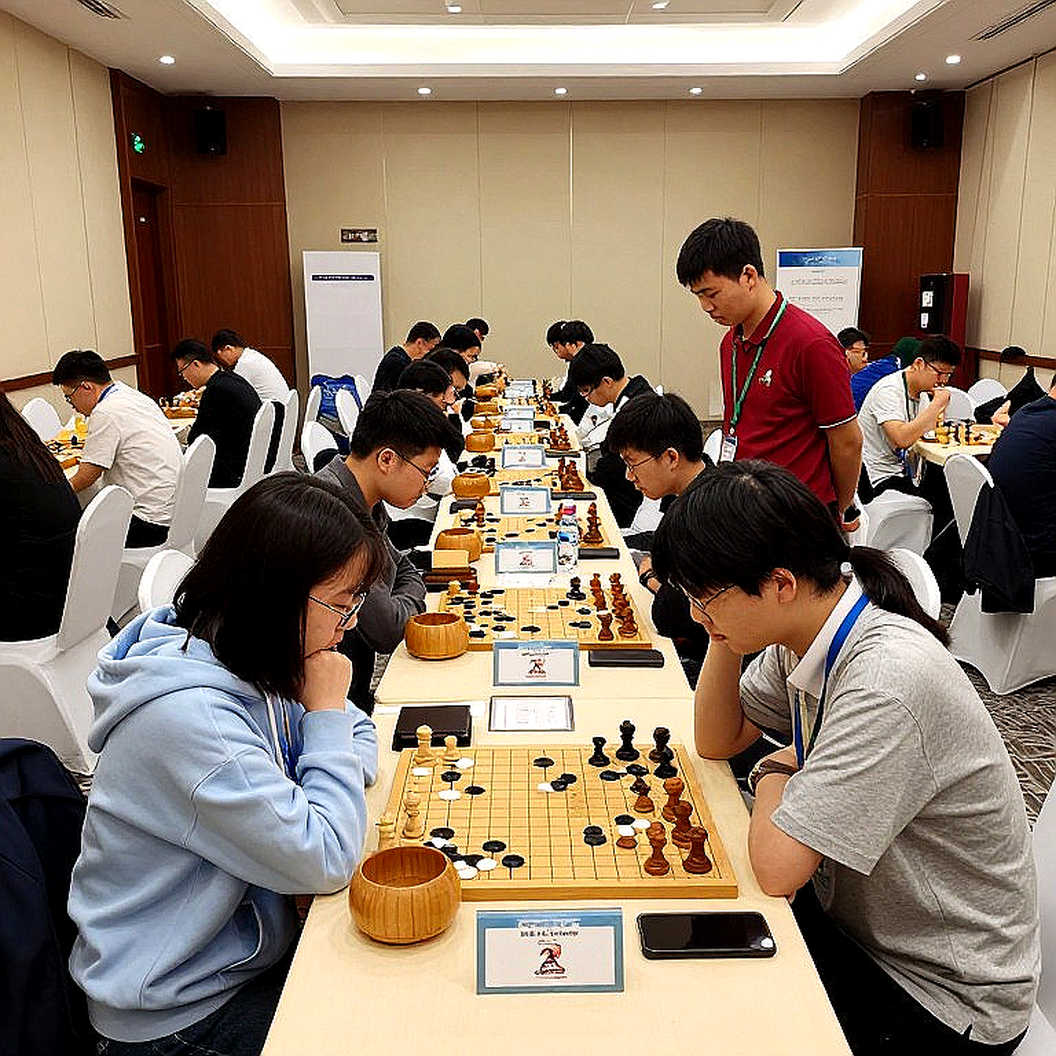
On the standings board of an open chess tournament held in Samarkand, entering Round 4, eight players sit on the same score. A reader sees the headline "an eight-way tie at the top" and immediately imagines a wide-open race in which any of the eight could take the title. Someone who has sat in a tournament control room, holding the pairing sheet, looks at that number and knows exactly where it came from.
I remember a summer evening in Hanoi, back when I was responsible for compiling results at a domestic open. After Round 4, the organisers read out a string of names on equal scores, and the hall buzzed as if it had just witnessed a desperate race. I sat down with the pairing sheet, counted the players, estimated the gap between the seeds and the rest, and answered myself: this outcome was almost inevitable. It took me a long time, after leaving the organiser's chair for analysis, before I could write the line I am most attached to: "No tactic is ever old; only the way we read a game can expire." That line did not come from a book. It came from an evening like that one.
The headline I just mentioned belongs to a piece on ChessBase, about Round 4 of the open section at Samarkand. The notable thing is that the piece is not a match report in the ordinary sense. Of its entire content, exactly one item concerns the tournament — the title line itself, "an eight-way tie at the top, favourites hold firm." The other ten items concern a product: ChessBase Magazine issue 225.
This is a structural feature anyone doing analysis must notice before going further: the article is a commercial product notice, not match journalism. The headline works as bait, not as a summary of results. Fail to distinguish the two, and a reader will happily turn an advertising line into a competitive finding.
So first, let us talk about the number eight.
The Swiss system pairs players against opponents on the same or a similar score each round, with no eliminations. That pairing method has a clear mathematical consequence: the earlier the tournament, the more players share a score, because few rounds have been played while the field is large. After Round 1, roughly half the players have a perfect score. After Round 2, that figure shrinks to a quarter. After Round 4, in an open with several hundred entrants, eight players sharing a score is well within what organisers expect.
In other words, an eight-way tie after Round 4 is not a development; it is a product of the pairing algorithm. It becomes notable only under one of two conditions: either a single player pulls clear, or the favourites get beaten. The original piece says the opposite — the favourites held firm. The strong players won as expected, crushing lower-rated opponents, and so the scores piled into a long line. A harmless long line. A tied score can impress, but a pairing sheet does not know how to lie.
There is a detail in the headline many readers skim past: the word "open" in brackets. That word tells us the subject is the open section — open to any eligible entrant — not the invitational Masters of the Samarkand chess festival. The open is where a wide range of playing strengths gather, so the tie story there carries even less competitive weight. It is a small detail, but it completely changes how the opening of the article should be read.
On the context of the Samarkand event, I can only speak within the limits of what the article supplies. The city sits in Uzbekistan, a region that has been adding chess tournaments in recent years. That an open is staged there shows the geography of chess events is expanding beyond the traditional centres of Europe and North America. But I stress: this is inference from general context, not information from the source. The source names no organiser, no sponsor, no prize fund, and not a single player from the event.
Once the bait is separated from the body, the remaining task is to read the body correctly. And the body of the source is devoted entirely to the product. Let me list what matters, the way an analyst reads a catalogue.
First, the "Special 27 miniatures" — twenty-seven short decisive games. In chess, a miniature usually ends inside roughly twenty-five moves. Its technical value lies mainly in the opening: it exposes early mistakes, lines refuted by tactical blows. It teaches almost nothing about the middlegame or the endgame. That the publisher chose to package this genre shows they are targeting club players who want quick, digestible fare rather than deep-reading subscribers. To be clear: this collection is high-grade entertainment, not training material in the strict sense. If you are looking for a middlegame curriculum, twenty-seven short games are not the place to look.
Next come ten opening articles bundled with repertoire ideas. That number is worth pausing over. A repertoire is the set of opening lines a player deliberately trains and repeats across many games. The value the publisher sells here is theory updating — a commodity with one of the shortest shelf lives in the computer era. A line described as new today can be neutralised within months, once databases absorb fresh games. I once spent an entire season memorising a single opening branch, only to find that within three months the whole branch had been refuted by a move I had never seen in any book. That is why I always tell younger players: study openings to understand principles, not to memorise move sequences.
Third, the opening videos by Werle, King and Ris. This is a Western European author cluster. The allocation shows the publisher's instructional contributor network remains concentrated in Europe. It also shows the publisher treats openings as the most reliably monetisable segment: ten written pieces plus three video specialists, while no endgame or strategy author is named. A magazine with no dedicated endgame author is a magazine betting on its readers' short-term needs.
Fourth, the analysis of games from the Prague 2026 Chess Festival, annotated by Aravindh, Giri, Gurel, Navara and others. The noteworthy point is that these are the players annotating their own games, following the magazine's long-standing format. Giri is a Dutch player ranked high among the world's elite and a familiar face at the Prague festival. Navara is the Czech number one, the natural domestic anchor for an event held in Czechia. Aravindh is an Indian grandmaster, and his presence in the annotation roster reflects the deepening integration of India's cohort into the European circuit. Gurel is most likely a young Turkish grandmaster, though the piece gives no full name, so I flag it here as pending verification. If correct, a junior-generation name entering the annotation pool is a small but trackable signal.
At the elite level, every player usually keeps a dedicated preparation assistant, responsible for digging deep into opening branches and finding moves never seen in a database. That the article describes games annotated by the players themselves, rather than by seconds or analysis teams, shows the product centres on the player's subjective viewpoint — a strength in storytelling, but also a technical limitation. An insider's view is always valuable, but it cannot replace the objective analysis of a third party with no interest in the game's result.
At the end of the piece, the distribution description is the most striking part. One content base, four formats: direct download; a PDF booklet; a booklet posted with a download key; and a "ChessBase Book" for iPad, tablet and Mac. For a chess publisher, simultaneously serving online users, offline learners, collectors who want a physical book in hand, and tablet users is a distribution architecture rarely seen in an age of platform dominance. This is the industrial detail that matters more than any opening statistic in the piece. It shows a customer segment still treats chess products as tangible possessions, not merely as access rights.
Let me say the plain thing: the source is a product notice dressed as news. The headline leans on a tournament, yet the body names not one more thing about that tournament — no leader, no score, no result. Ten of the eleven information points revolve around the product. Someone reading only the headline will believe they just read Samarkand news. A careful reader will know they just read an advertisement. The chess content market is like a chess game, not a round of card-drawing — but many publishers prefer to flip cards.
There is a geographical asymmetry worth tracking here. A tournament in Samarkand, Uzbekistan is chosen as the headline lure, while the annotation and content-production resources come from the Netherlands, England and Czechia. The geography of chess events is diversifying faster than the geography of chess content production. Host cities of opens gain prestige while publishers gain margin. That is the valley of the value chain, and it repeats across many sports. Football is the same: a tournament in Asia or Africa can generate matches worth watching, but most of the analysis money, data and content flows to media centres in Europe. Chess is repeating that exact model, only at a slower pace.
I also want to address the opening-theory treadmill. A magazine reports opening developments and sells opening repertoires. Its incentive is tied to the perception that theory runs faster than a reader can keep up. That perception deserves to be treated as a hypothesis, not an obvious truth. To test it, a player need only ask: in the last six months, did any line in my repertoire get neutralised badly enough to require a change, and when I changed it, did my results improve? If the answer is no, then that treadmill is spinning more for the seller's benefit than the buyer's.
On the competitive side, I must add this: names like Giri, Navara and Aravindh function in the article as brand assets, not as data subjects. They are cited to vouch for product authority — "world-class players annotate their brilliant games" — yet no Elo, result or record is attached to any of them. Readers should not mistake a brand-name citation for evidence of form. Their presence tells us there were games worth publishing, not whether they are playing well or badly.
There is another gap I noticed in the piece: no mention of preparation assistants, of automated analysis tools, or of any AI-linked training feature. The product is described as entirely human-authored content. This may be a deliberate positioning choice, or it may be a lag behind newly arrived algorithm-driven training products. I do not have enough data to say which. But I will watch the next issue to see whether that gap gets filled.
Round 4 of an open in Samarkand tells us nothing about who will win. It tells us only that the favourites are doing what everyone expects them to do at a stage when everyone expects it. The article I read tells us something else, and something more interesting: how a chess publisher turns a score line into a doorway to a product catalogue, and how an event in Central Asia becomes raw material for a content machine in Western Europe.
Next time I come across a chess headline that smells like news, I will ask myself one question: does the body deserve the opening?
Cầu thủ liên quan
Bài nổi bật
Collapse in Three Moves, Still 'Player of the Day': The Real Meaning Behind the Nihal Sarin Decision2026-09-24
Samarkand R4: Is the Eight-Way Lead Just a Swiss System Illusion?2026-09-21
Samarkand Round 4: Eight-Way Tie at the Top — and 10 of 11 Information Points That Never Mention the Tournament2026-09-21
Samarkand Open Round 4: An Eight-Way Tie and What the Headline Doesn't Say2026-09-20
Six Videos, Seven Openings and One Bait Name: Decoding the Fear Called the London System2026-09-15
The Elephant Gambit 2…d5: Surprise Weaponry and Its Bill in the Database Era2026-09-13
ChessBase and Karsten Müller: 25 Years of Teaching Chess Endgames Anew2026-09-13
Bài đề xuất
David Antón leads 'Legends & Prodigies': Genuine victory or marketing bait?2026-09-11
Seven Systems in Six Videos: Anatomy of a Black Repertoire Against 1.d4 and the Grey Zone of the Chess Course Market2026-09-23
Karsten Müller and 25 Years of Sowing the Seeds of Endgame Mastery2026-09-13
Nihal Sarin, a +2 Position and Three Moves That Dropped a Crown: Anatomy of the Collapse at the Tashkent Chess Olympiad2026-09-23
Chess Festival Prague 2026: 27 captivating miniatures and in-depth analysis in ChessBase Magazine #2252026-09-09
Savitha Shri's 5/5 and the Weight of the Lower Boards: India's Women's Team Medal Puzzle at the Samarkand Olympiad2026-09-23
Sixty Minutes for a Gamble: The Elephant Gambit and the Trust Problem in Chess Publishing2026-09-13
Samarkand Round 4: Eight-Way Tie at the Top — and 10 of 11 Information Points That Never Mention the Tournament2026-09-21
Bài đề xuất
The Elephant Gambit 2...d5: The Shelf Life of a Surprise Weapon2026-09-13
Nihal Sarin and the Fateful Move: When Victory Within Reach Became a Lesson in Team Culture2026-09-24
The Scotch Game: From Lyon 2026 to Mikhalchishin's 60-Minute Lecture2026-09-23
The Blank Dossier at Luzhniki: The Transfer Market, the Patch, and What Football Never Records2026-09-11
The Elephant Gambit: A 60-Minute Bet and What the Data Does Not Say2026-09-25
GCL 2026: Nepomniachtchi gives Carlsen a scare before beating Sindarov on the clock2026-09-08
David Antón leads 'Legends & Prodigies': Genuine victory or marketing bait?2026-09-11
Collapse in Three Moves, Still 'Player of the Day': The Real Meaning Behind the Nihal Sarin Decision2026-09-24